
Amla oil for hair growth is one of the most enduring searches in natural hair care — and unlike passing trends, amla has earned its reputation over thousands of years. The Indian gooseberry (Emblica officinalis), known as amla, sits at the heart of classical Ayurvedic hair care, prized especially for its remarkable vitamin C content and its traditional association with dark, lustrous, youthful-looking hair. Here’s how to use it the right way.
What Is Amla Oil?
Amla oil is made by infusing dried amla fruit into a carrier oil, traditionally coconut or sesame. The fruit itself is extraordinary: one of nature’s richest sources of vitamin C, along with a spectrum of antioxidants and tannins that traditional Ayurvedic texts have valued for hair and scalp care for millennia.
In Sri Lanka’s Ayurvedic tradition, amla preparations are classic — found in everything from hair oils to the revered triphala blend. It is the ingredient grandmothers reached for when they wanted hair that looked thick, dark, and full of life.
Traditional Benefits of Amla Oil for Hair
In traditional Ayurvedic practice, amla oil is used to:
- Support the appearance of thicker, fuller-looking hair — regular scalp oiling with amla is the classical routine for hair that looks abundant and healthy.
- Maintain natural-looking hair colour — amla is traditionally associated with delaying the appearance of premature greying. (It cannot reverse greying that has occurred or change genetics — but as a traditional supportive ritual, it is unmatched.)
- Nourish the scalp — amla-infused oil is traditionally massaged into the scalp to support a comfortable, balanced-feeling scalp environment.
- Add natural shine and softness — the tannins and antioxidants in amla are traditionally valued for hair that looks glossy and feels smooth.
As always: these are traditional wellness uses, not medical claims. Amla oil is a nourishing ritual for beautiful-looking hair — a heritage habit, not a cure.
The Right Way to Use Amla Oil: The Ritual
The Weekly Deep-Oiling Ritual
- Warm the oil. Place your bottle in warm water for a couple of minutes.
- Section and massage. Part hair into sections and massage into the scalp with fingertips for 5–10 minutes.
- Work through the lengths. A small amount through mid-lengths and ends adds shine without heaviness.
- Leave for 1–2 hours, or overnight. Cover with a shower cap or towel.
- Wash thoroughly. One or two gentle shampoos will remove it.
The Pre-Wash Boost
No time for a full ritual? Massage amla oil into your scalp 30 minutes before shampooing, once or twice a week.
Amla and Premature Greying: The Traditional View
Ayurvedic tradition holds amla in the highest regard for maintaining youthful-looking hair colour. What it cannot do is reverse grey hair or override genetics. Think of amla oil as traditional support for hair that looks its darkest and healthiest — a ritual of care, not a colour treatment.
Choosing a Genuine Amla Oil
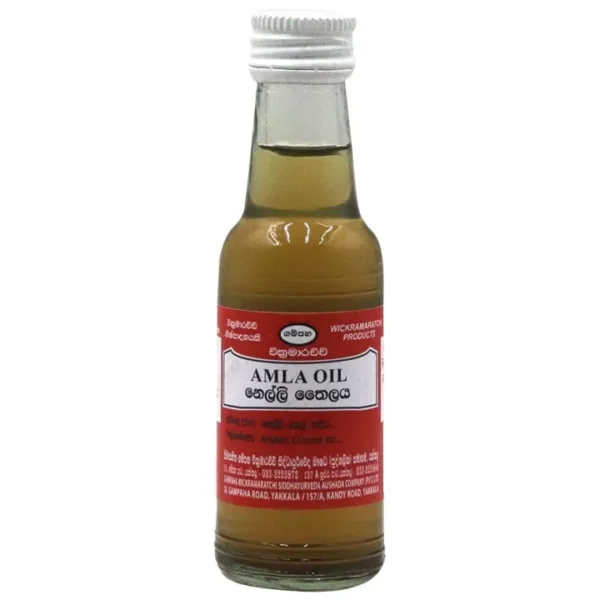
Look for an oil where amla is a real infused ingredient — not just fragrance. Amla 60ml follows this traditional method, prepared in the Wickramarachchi Ayurvedic lineage of Yakkala, Sri Lanka — since 1929. “Rooted in Ceylon. Crafted for the World.”
Frequently Asked Questions
How often should I use amla oil for hair growth?
One to two deep-oiling sessions per week is the traditional rhythm. Consistency over weeks is what traditional practice emphasises.
Can amla oil reverse grey hair?
No oil can reverse greying. Amla is traditionally used to support the appearance of naturally dark, healthy-looking hair — a supportive ritual, not a colour cure.
Is amla oil suitable for all hair types?
Yes — it’s one of the lighter Ayurvedic hair oils, suiting fine hair as well as thick or curly hair.
Does amla oil stain?
It can have a slight tint — use an old towel for overnight treatments. It washes out of hair easily.
What are the traditional benefits of amla oil for hair?
In traditional Ayurvedic practice, amla oil is used to support the appearance of thicker, fuller-looking hair; to maintain natural-looking hair colour; to nourish the scalp; and to add natural shine and softness. These are traditional wellness uses — a nourishing heritage ritual, not medical claims.
Can amla oil reverse grey hair?
No oil can reverse greying or override genetics. Amla is traditionally valued in Ayurveda for supporting the appearance of naturally dark, healthy-looking hair and maintaining youthful-looking colour — a supportive ritual of care, not a colour treatment.
How often should you use amla oil?
One to two deep-oiling sessions per week is the traditional rhythm: warm the oil, massage into the scalp for 5–10 minutes, work a little through the lengths, leave for 1–2 hours or overnight, then wash out. Amla oil is lighter than many hair oils and washes out easily.
Is amla oil suitable for fine hair?
Yes — amla oil is one of the lighter Ayurvedic hair oils, so it suits fine hair as well as thick or curly hair. A small amount through the mid-lengths adds shine without heaviness.
Continue your ritual


[…] Amla Oil for Hair: Benefits and the Right Way to Use It […]
[…] Amla Oil for Hair: Benefits and the Right Way to Use It […]
[…] Amla Oil for Hair: Benefits and the Right Way to Use It […]