
If you’ve been searching bhringraj oil for hair growth, you’ve probably noticed the same quiet promise repeated across the internet: patience. In Ayurveda, bhringraj — Eclipta prostrata, the “king of herbs for hair” — has been the centrepiece of hair rituals for centuries, not as a quick fix, but as a practice. This guide explains how bhringraj oil is traditionally used, how long people have actually committed to it before judging it, and how to choose between two very different expressions of it from Ceylon.
What Bhringraj Oil Is (and Why Hair Rituals Still Centre It)
Bhringraj is a small, trailing herb whose leaves are traditionally pressed into warm base oils for head massage. In the Ayurvedic tradition, the emphasis has never been on the oil alone — it’s on the ritual: warm oil, unhurried fingertips, regular evenings, restful sleep afterwards. The scalp is considered the root of healthy hair; a cared-for scalp, tended consistently, is the whole philosophy.
What modern Western buyers appreciate is simpler: a grounding weekly ritual that doubles as a moment of calm, rooted in a tradition that treats hair care as self-care rather than problem-fixing.
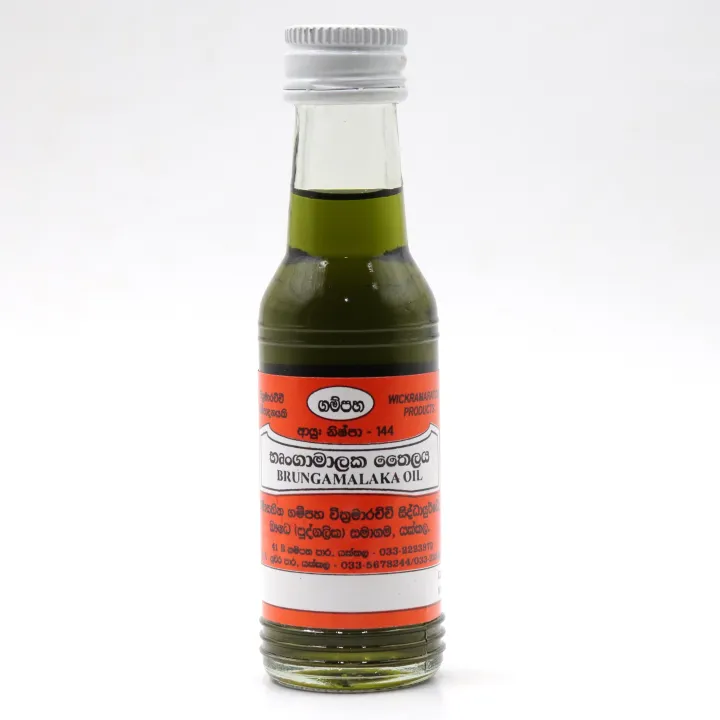
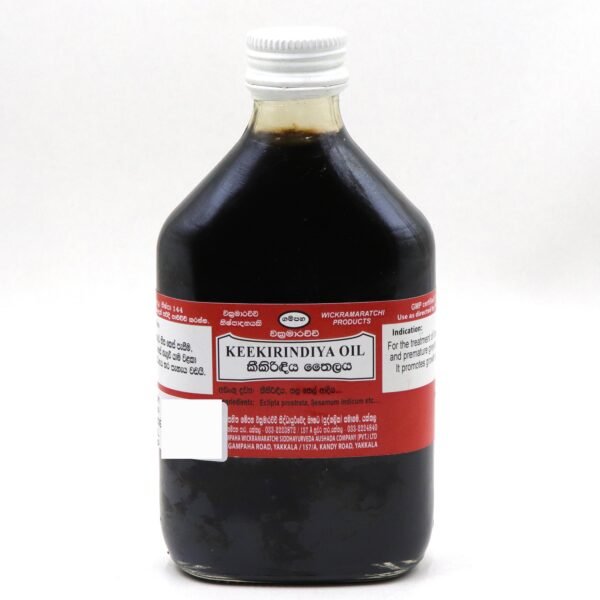
Brungamalaka vs. Keekirindiya: Two Ceylon Expressions of Bhringraj
Both of our bhringraj oils come from the Wickramarachchi Ayurveda tradition of Yakkala, Sri Lanka — a lineage dating to 1929. But they are genuinely different products, and choosing between them is a matter of temperament.
Brungamalaka — The Classical Heritage Formula
Brungamalaka is a traditional multi-herb preparation built around bhringraj, made the way classical formulas have been composed for generations: several botanicals prepared together in oil, layered for a rounded, time-honoured character. If you love the idea of a heritage recipe — the full ceremony, the old way — this is the one.
Keekirindiya 180ml — The Single-Herb Purist
Keekirindiya (the Sinhala name for the bhringraj plant, Eclipta prostrata) is the minimalist’s bhringraj: the single herb, prepared in oil, nothing else competing for attention. Choose it if you like your rituals simple and your ingredient lists short — one herb, one oil, one purpose.
Neither is “better.” A classical formula and a single-herb oil are different aesthetic choices within the same tradition.
How to Use Bhringraj Oil: The Traditional Ritual
What you’ll need: your chosen bhringraj oil, a towel, and twenty unhurried minutes.
- Warm it, gently. Stand the bottle in a bowl of warm (not hot) water for a few minutes. Never microwave it.
- Section and apply. Part your hair in sections and apply the oil directly to the scalp with your fingertips — a little at a time.
- Massage for 5–10 minutes. Use the pads of your fingers (not nails) in slow circles across the whole scalp.
- Leave it in. Traditionally 30–60 minutes; many prefer overnight with a towel over the pillow.
- Wash out gently. A mild shampoo, usually twice, removes the oil without stripping the scalp.
How often? Traditional practice suggests 2–3 times per week. Consistency matters far more than quantity.
How Long Does It Take? An Honest Answer
Ayurvedic hair practice was never built on timelines; it was built on seasons of consistent care. Hair grows slowly — roughly a centimetre a month — so any hair ritual needs time. As a working guideline: commit to the ritual 2–3 times weekly for at least 8–12 weeks before forming a judgement. Take a photo on day one.
What we won’t promise: guaranteed results on a fixed date. A time-honoured ritual, practised patiently, is the honest offer.
A Note on Sourcing
Much of the bhringraj oil sold online is mass-produced far from any Ayurvedic lineage. Ours is made in Sri Lanka within the Wickramarachchi tradition — “Rooted in Ceylon. Crafted for the World.”
FAQ
How often should I use bhringraj oil for hair fall concerns?
Traditional practice suggests 2–3 times per week with a proper scalp massage each time.
Should I leave bhringraj oil overnight?
You can. Overnight application with a towel protecting the pillow is a common variation.
Which is better — Brungamalaka or Keekirindiya?
They’re different expressions of the same herb. Brungamalaka is a classical multi-herb heritage formula; Keekirindiya 180ml is a single-herb bhringraj oil for purists.
Can I use bhringraj oil if I have an oily scalp?
Yes — apply a smaller amount, focus on massage rather than saturation, and wash out thoroughly.
How long does bhringraj oil take to show results?
Ayurvedic hair practice is built on consistency rather than timelines, but as a working guideline: commit to the ritual 2–3 times weekly for at least 8–12 weeks before judging it. Hair grows roughly a centimetre a month, so patience is part of the method — and no brand should guarantee results on a fixed date.
What is the difference between Brungamalaka and Keekirindiya bhringraj oil?
They are two expressions of the same herb from the Wickramarachchi tradition. Brungamalaka is a classical multi-herb heritage formula built around bhringraj; Keekirindiya (180ml) is the single-herb purist oil — one herb, one oil. Choose by temperament: ceremony or simplicity.
How do you use bhringraj oil the traditional way?
Warm the oil gently (never microwave), part the hair and apply to the scalp with fingertips, massage in slow circles for 5–10 minutes, leave for 30–60 minutes or overnight, then wash out with a mild shampoo. Traditional practice suggests 2–3 sessions per week.
Can I use bhringraj oil if I have an oily scalp?
Yes — apply a smaller amount, focus on the massage rather than saturation, and wash out thoroughly with a mild shampoo. If your scalp feels uncomfortable, reduce frequency to once a week.
Continue your ritual


[…] Bhringraj Oil for Hair Fall: How to Use It & Timelines […]
[…] Bhringraj Oil for Hair Fall: How to Use It (and How Long It Takes) […]
[…] Bhringraj Oil for Hair Fall: How to Use It (and How Long It Takes) […]